
Getting a straight answer on what AV installation costs is harder than it should be. Every home is different, and quotes swing wildly depending on the scope of work, the equipment tier, and how much of the house needs new wiring. This guide breaks down realistic price ranges for the most common projects in Tampa Bay and, more usefully, explains what actually moves the number up or down.
Looking for smart home automation pricing specifically? See our Smart Home Automation Cost guide.
Home Theater Installation: $3,000–$25,000+
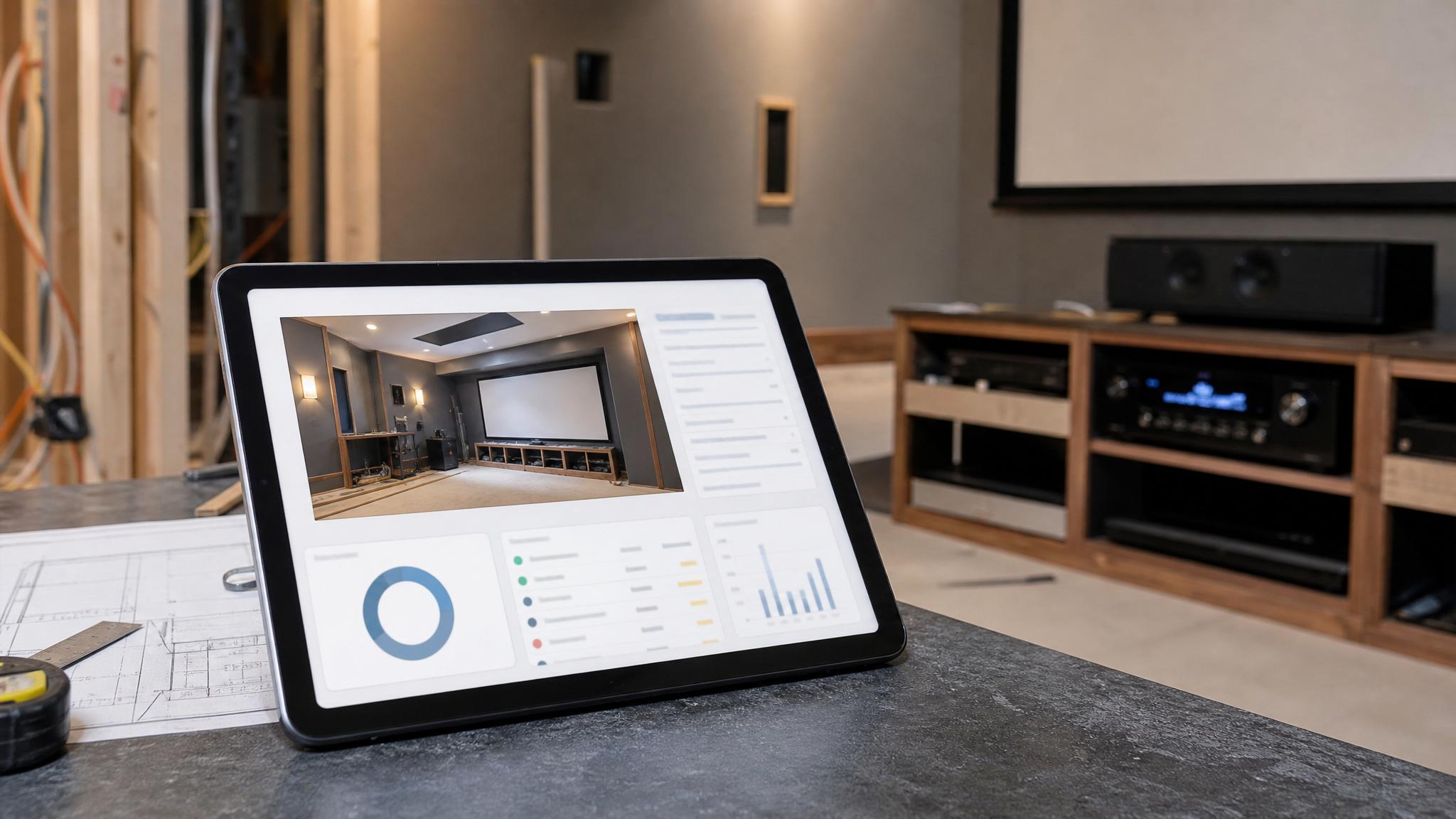
A basic home theater — a large-format TV, a soundbar or 5.1 speaker package, and a universal remote — can be done for $3,000–$6,000 including mounting, wiring concealment, and calibration. Step up to a dedicated theater room with a projector, a motorized screen, in-wall or in-ceiling Atmos speakers, and acoustic treatment, and you're realistically looking at $12,000–$25,000. The projector and screen alone can account for a third of that budget; a good 4K laser projector runs $2,500–$8,000 before you've bought a screen to put it on.
The single biggest cost driver isn't the gear — it's the room. Running speaker wire and HDMI through existing drywall (retrofit) costs significantly more in labor than running the same wire during new construction or a renovation when the walls are already open. If you're planning a remodel anyway, that's the cheapest possible time to get wiring done.
Whole-Home Audio: $5,000–$30,000+
Pricing here scales almost linearly with the number of zones (rooms) you want covered. A modest 3-zone system — say, kitchen, living room, and primary bedroom — typically runs $5,000–$9,000 installed. A true whole-home system covering 8-10 zones including outdoor areas can run $20,000-$30,000, especially if you want independent volume and source control in every room rather than a single synced zone.
Wired systems (in-ceiling speakers on dedicated amplifier channels) cost more upfront than wireless multi-room speakers, but they hold their value better, don't depend on Wi-Fi reliability, and don't clutter rooms with visible hardware. For a full-time residence you plan to stay in for years, wired is usually the better long-term investment even though the sticker price is higher.
Structured Wiring and Networking: $1,500–$8,000
Often overlooked, but it's the foundation everything else sits on. Running Cat6 to every room, a couple of dedicated access point locations for solid Wi-Fi coverage, and a proper equipment rack or cabinet typically runs $1,500-$4,000 in an average-size home. Larger homes, homes with detached structures (pool houses, garages, guest suites), or homes wanting fiber runs between buildings will land higher.
If you only do one thing before finishing a renovation, make it this. Retrofitting network cabling into finished walls later is dramatically more expensive and disruptive than running it while the walls are open.
What Actually Moves the Price
- Retrofit vs. new construction/renovation. Open walls save real money on labor.
- Equipment tier. Consumer-grade vs. commercial-grade gear can be a 2-3x difference for similar functionality.
- Number of rooms/zones. Pricing scales with coverage area, not just square footage.
- Integration complexity. Getting five systems to talk to each other and to one app costs more than five systems that each work independently.
- Site conditions. Tricky attic access, concrete block construction (common in Florida), or long cable runs between structures all add labor time.
Getting an Accurate Quote
Because scope varies so much, a phone estimate is never going to be reliable. A proper quote requires either a site visit or, at minimum, floor plans and a clear room-by-room list of what you want. Be specific about priorities — "I want great sound in the living room and don't care about the bedrooms" gets you a very different (and cheaper) quote than "I want everything, everywhere."