
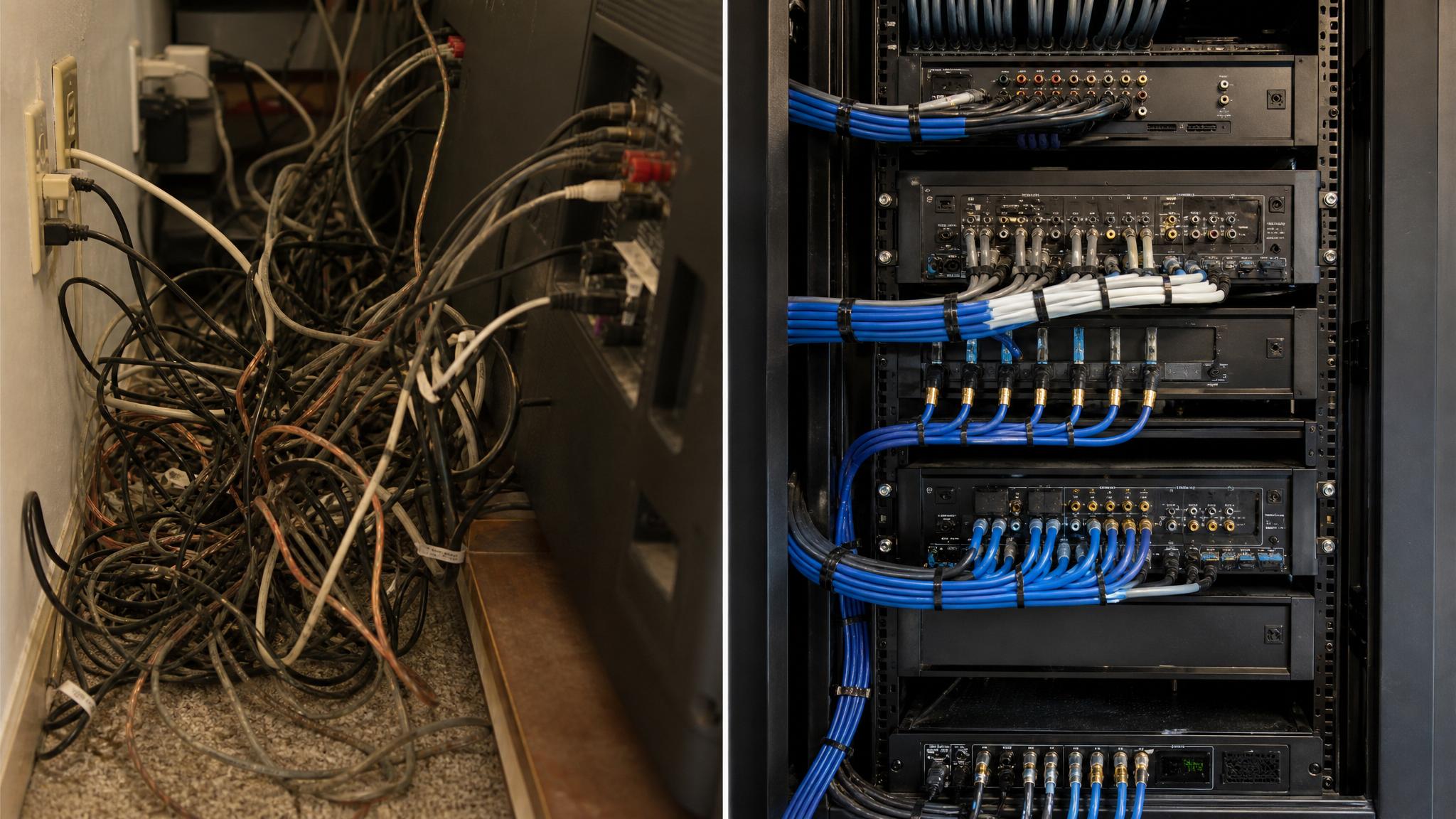
Mounting a TV and plugging in a soundbar is a Saturday afternoon project. Wiring a whole-home audio system, calibrating a surround sound setup, or programming a smart home platform is a different category of work entirely. The honest answer to "should I DIY this?" depends heavily on which project you're actually talking about.
Where DIY Genuinely Makes Sense
- Single-TV setups. Mounting a TV, connecting a soundbar, and running a short HDMI cable is well within reach for most homeowners with basic tools.
- Off-the-shelf smart speakers. A couple of Wi-Fi smart speakers or a single smart display is plug-and-play by design.
- Basic smart bulbs and plugs. These are consumer products built for zero-install setup.
- Simple streaming devices. Adding a streaming stick or box to an existing TV requires no special skill.
If your project fits in one of these buckets, hiring a professional is probably overkill. Save the money.
Where DIY Gets Expensive Fast
Wiring. Running speaker wire, HDMI, or Cat6 through finished walls without the right tools (fish tapes, wall-rated cable, proper connectors) leads to two common outcomes: visible cable clutter, or damaged drywall from repeated access attempts. Low-voltage wiring also has real code considerations — plenum-rated cable is required in air handling spaces, and improperly run wiring can be a fire code issue during a home sale inspection.
Whole-home audio and multi-room systems. Getting multiple zones to sync properly, route the right source to the right room, and integrate with existing home Wi-Fi without interference is genuinely technical work. DIY multi-room setups frequently end up as several disconnected single-room systems instead of one coherent whole-home system — which defeats the point.
Home theater calibration. Buying good speakers and a good projector doesn't mean you're hearing or seeing them at their best. Proper speaker placement, room acoustic treatment, and audio/video calibration (setting speaker levels, crossover points, and display color/gamma) make a measurable difference that most DIY installs skip entirely, because the tools and knowledge to do it right aren't part of a typical consumer's toolkit.
Smart home integration. This is where DIY struggles the most. Individually, smart devices from different brands often work fine. Getting them to work together — a single app controlling lighting, climate, security, and AV with reliable automations — usually requires a hub/platform and configuration expertise that goes well beyond following a device's included instructions.
The Hidden Cost of Redoing DIY Work
The real cost of a DIY project that doesn't work out isn't just your time — it's paying twice. Professional integrators regularly get called in to fix DIY installs where wiring has to be pulled back out of walls, mounting hardware wasn't rated for the wall type, or a smart home setup has to be unwound and rebuilt from scratch because the platform choice didn't scale. That "free" DIY labor can end up costing more than professional installation would have in the first place, plus the drywall repair.
Warranty and Liability
Professional installers typically carry liability insurance and back their work with a service warranty — if a speaker fails or a smart home controller stops responding six months later, that's a phone call, not a project. DIY installs have no such backstop. For anything involving in-wall wiring, ceiling-mounted equipment, or electrical work, that liability coverage matters more than most people think about upfront.
A Simple Decision Framework
Ask yourself three questions:
- Does this involve running wire through finished walls or ceilings? If yes, lean professional.
- Does this involve getting multiple devices or rooms to work together as one system? If yes, lean professional.
- Is this a single device doing one job, with no wiring beyond what's already there? If yes, DIY is probably fine.
Most homeowners land somewhere in between — DIY-ing the easy parts and bringing in a professional for the wiring, calibration, or whole-home integration. That hybrid approach is often the most cost-effective path: you're not paying labor for what you could do yourself, and you're not risking a redo on the parts that actually require expertise.