
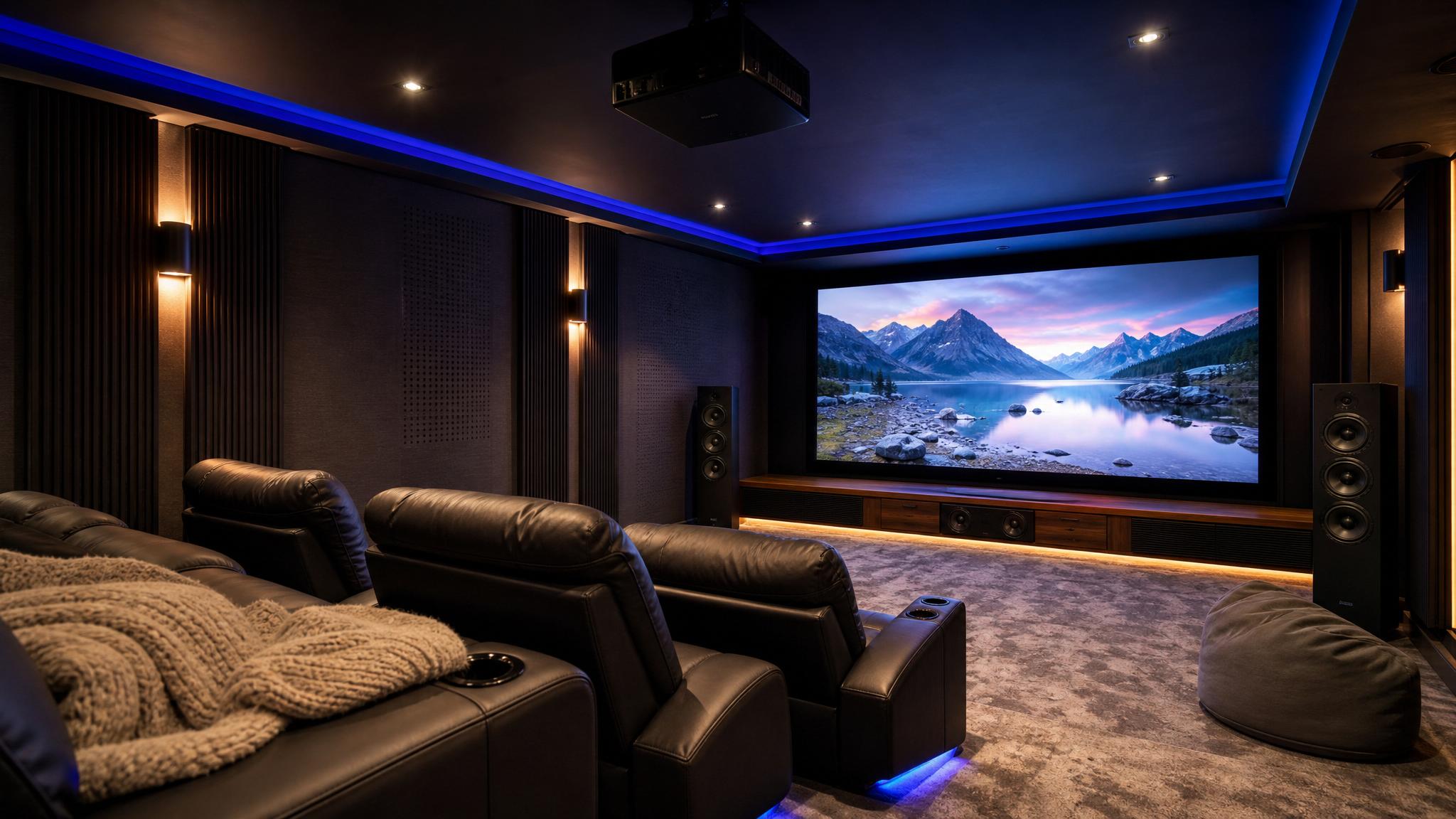
A home theater lives or dies on a handful of decisions made before any equipment is purchased: how big the screen should be, whether to go with a projector or a large-format TV, what surround sound format makes sense for the room, and whether the room itself needs acoustic treatment. Get these right and even a modest budget performs well. Get them wrong and even expensive equipment can disappoint.
Screen Size: There's Actual Math For This
The most common home theater mistake is a screen that's too small for the room. THX and SMPTE both publish viewing angle guidelines, and the practical takeaway is simple: for an immersive experience, the screen should fill roughly 30-40 degrees of your field of view at your primary seating distance. As a rough rule of thumb:
- 8-foot viewing distance: 65-75" screen
- 10-foot viewing distance: 85-100" screen
- 12-foot viewing distance: 100-120"+ screen (this is where projection usually takes over from flat-panel TVs)
If your existing TV feels small in the room, this is almost always why — it was sized for a showroom, not your actual seating distance.
Projector vs. TV
This decision mostly comes down to two things: ambient light and screen size goals.
TVs handle ambient light far better, require no dedicated dark room, and modern OLED and mini-LED panels deliver excellent contrast and brightness even in daytime viewing. They top out in size (very large panels get expensive fast) but for most rooms that double as living spaces, a large-format TV is the practical choice.
Projectors win decisively once you want a truly large image (100"+) at a reasonable cost, and they're the only realistic path to a cinema-scale screen. The tradeoff is light control — projectors perform best in rooms that can be reasonably darkened, and ambient light washes out contrast noticeably more than it affects a TV. A dedicated theater room with light control is the ideal projector environment; a great room with large windows is not.
Surround Sound: Matching the Format to the Room
- Soundbar / 2.1 setup — a real upgrade over TV speakers, works in any room, no wiring required. The ceiling of what a soundbar can do.
- 5.1 surround — front left/center/right, two rear surrounds, and a subwoofer. This is the traditional home theater baseline and delivers a genuinely immersive experience for movies and games.
- 7.1 surround — adds side surrounds for larger rooms, filling in the sound field between front and rear channels.
- Dolby Atmos / DTS:X (object-based formats) — adds height channels, either via in-ceiling speakers or upward-firing modules, so sound moves overhead as well as around you. This is the current high-end standard and makes the biggest single difference in immersion of any upgrade beyond basic 5.1.
For a dedicated theater room, 5.1 or 7.1 with Atmos height channels is the sweet spot most integrators recommend. For a media room that's also a living space, a high-quality soundbar with Atmos support is a reasonable compromise that doesn't require running speaker wire to the rear of the room.
Acoustic Treatment Matters More Than People Expect
Speaker quality gets all the attention, but room acoustics have an enormous effect on how a system actually sounds. Hard, parallel surfaces (bare walls, tile or hardwood floors, large windows) cause reflections and echo that muddy dialogue and blur detail. Basic acoustic treatment — a rug, curtains, a few strategically placed acoustic panels — can improve perceived sound quality more than a speaker upgrade would, for a fraction of the cost. Dedicated theater rooms benefit the most from this since they tend to have harder surfaces and less soft furnishing than a typical living room.
Budget Tiers, Realistically
- Entry ($3,000-$6,000): Large-format TV, soundbar or basic 5.1 system, universal remote, professional mounting and wiring.
- Mid-range ($8,000-$15,000): Projector or premium TV, proper 5.1 or 7.1 speaker system, AV receiver, basic acoustic treatment, professional calibration.
- Dedicated theater ($15,000-$25,000+): 4K laser projector with motorized screen, in-ceiling Atmos speakers, full acoustic treatment, theater seating, and a control system tying it all together.
Putting It Together
Start with the room, not the equipment list. Measure your actual seating distance before picking a screen size. Be honest about how much light control the room realistically has before committing to a projector. And budget for acoustic treatment as part of the system, not an afterthought — it's often the difference between a home theater that sounds good and one that just has good speakers in it.