
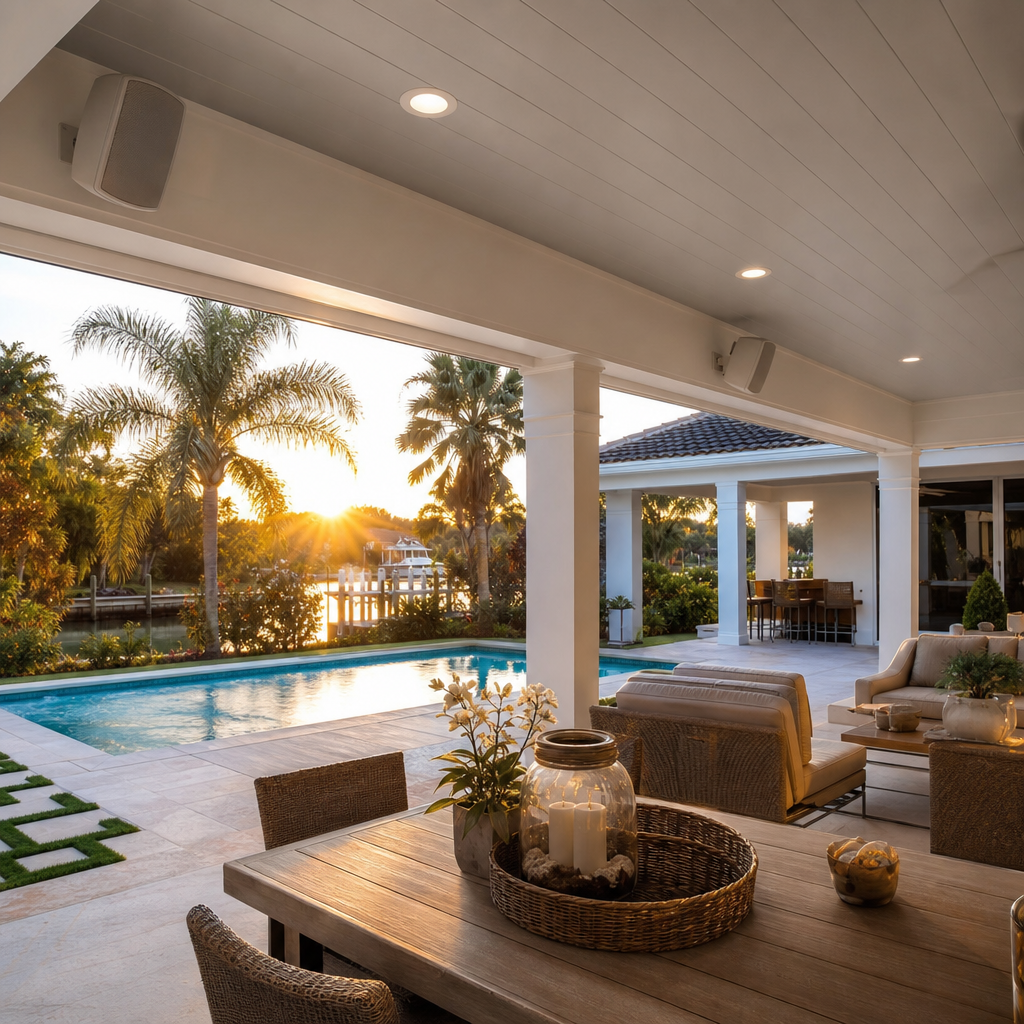
Outdoor audio in Florida has to survive conditions that most speaker equipment was never designed for: direct sun and UV exposure, high humidity nearly year-round, salt air for coastal properties, and the occasional tropical downpour. Getting outdoor audio right is less about finding great-sounding speakers (most decent outdoor speakers sound fine) and much more about picking equipment that will actually survive the environment.
Understanding Weatherproof Ratings
Look for an actual IP (Ingress Protection) rating rather than marketing language like "weather resistant," which has no standardized meaning. The rating format is two digits: the first covers dust/particle resistance, the second covers moisture resistance. For Florida outdoor use:
- IP54 or IP55 — reasonable minimum for a covered patio or lanai with indirect weather exposure.
- IP65+ — appropriate for fully exposed locations facing direct rain and sun.
- Marine-grade — speakers specifically built for boats, using UV-stabilized materials and fully sealed/corrosion-resistant hardware. Worth considering for coastal properties or fully exposed pool decks, even beyond a standard IP rating, because of the added UV and salt-air durability.
A speaker without a clear published IP rating shouldn't be assumed weatherproof, regardless of how it's marketed.
Landscape Speakers vs. In-Ceiling Patio Speakers
In-ceiling/in-eave speakers work well under a covered patio, lanai, or porch roof where there's overhead structure to mount into. They stay visually unobtrusive and, being under cover, face less direct weather exposure than fully exposed placements — though they still need a genuine outdoor rating for humidity and temperature swings.
Landscape (rock or ground-stake style) speakers are designed for open, uncovered areas — around a pool deck, along a garden path, or scattered through a yard for broader coverage. These are built as fully self-contained outdoor units and tend to have the highest weather ratings of any outdoor speaker category, since they have no covered structure protecting them at all.
In-wall/on-wall exterior speakers, mounted directly to an exterior wall under an eave, are a middle ground — good coverage for a patio area without ceiling access, still benefiting from some overhang protection.
Pool Area Electrical Safety
Any electrical work near a pool — including outdoor speaker wiring and amplifier placement — needs to respect code-mandated clearance distances from the water's edge, and equipment powering pool-area audio should be on a GFCI-protected circuit. This isn't optional or a minor detail: it's both a safety requirement and typically an inspection point if the work is ever reviewed during a home sale. Amplifiers and other powered equipment should be located indoors or in a protected equipment closet, with only the speakers themselves (which are low-voltage) actually located in the outdoor/pool area.
Humidity's Effect on Non-Rated Equipment
Standard indoor speakers, even placed under cover, will typically fail within a year or two outdoors in Florida due to humidity working into the driver components and any exposed wood or paper cone materials warping or delaminating. This is the single most common outdoor audio mistake — using leftover indoor speakers in a covered outdoor space because "it's not getting rained on." Consistent high humidity alone is enough to degrade non-rated equipment even without direct rain exposure.
Wiring Considerations
Outdoor speaker wire should be rated for direct burial or outdoor use specifically (not standard indoor speaker wire run outside), and any wire entering the house through an exterior wall needs to be properly sealed against moisture intrusion at the entry point. For landscape speakers spread across a yard, running wire in conduit both protects the cable and makes future troubleshooting or replacement significantly easier than digging up buried, unprotected wire.
Planning an Outdoor Zone
A well-planned outdoor audio zone typically separates into two categories: a covered patio/lanai area (in-ceiling speakers, moderate IP rating sufficient) and any fully exposed area like a pool deck or open yard (landscape speakers, highest IP rating, GFCI-protected amplification kept indoors). Treating "outdoor" as a single uniform environment often leads to underspecced equipment in the more exposed zones — the pool deck and the covered lanai have genuinely different requirements, even though they're both technically "outside."